Full Name: John Bunyan Birth Place: Bedford, England Parents: Thomas Bunyan and Margaret Bentley Wife: Mary Born: November 1628 Died: August 31, 1688 Salvation Experience: At 25 years of age Famous Work:“The Pilgrim’s Progress” — one of the most popular books after the Bible.
Life Story
John Bunyan was born in Bedford, England, into a poor family. His father was a tinker who repaired pots and pans. John grew up as a naughty and careless boy, used to lying and stealing. He didn’t study much but learned to read and write.
In 1644, his mother and sister died, and soon after, his father remarried. Feeling lonely and hurt, John became bitter and turned away from God. Later, he joined the army and served for two years. Once, when another soldier took John’s place in battle, that soldier was killed. John realized that God had saved his life for a purpose.
After leaving the army, he started working as a tinker like his father. He married a poor but godly woman named Mary. They were poor but faithful to attend church. John read many Christian books and began to think deeply about sin, judgment, and salvation.
Through the help of some Christian women and Pastor Gifford, John came to know the truth of the Gospel. He confessed his sins and accepted Jesus Christ as his Savior. His life completely changed. Even in suffering, he trusted God and continued to preach about Christ.
Ministry and Imprisonment
John’s daughter was born blind, and soon after, his wife died. Even then, he never lost faith. During that time, England had a law that only licensed ministers could preach. But John boldly declared, “Woe to me if I do not preach the Gospel!”
He preached to large crowds with great power. Because of his preaching, he was arrested and put in prison. The officials told him he could be free if he promised not to preach again — but John refused. He said, “If you release me today, I will preach again tomorrow.”
He spent 12 years in prison, yet used that time to pray, teach other prisoners, and write. During that period, he wrote “The Pilgrim’s Progress,” one of the greatest Christian books ever written — now translated into more than 100 languages.
Later Years
After his release at age 43, John continued preaching and wrote another great book called “The Holy War.” He became a pastor of the Baptist Church in Bedford and helped many people grow in faith.
He wrote more than 20 books in total. On August 31, 1688, John Bunyan went to be with the Lord, faithful till his last breath.
Famous Quote
“It is better to obey God than men.”
Message from His Life
John Bunyan’s story teaches us:
God can change any sinner into His servant.
Obedience to God is more important than pleasing people.
Ezra is one of the quiet but powerful leaders in the Bible. He was a priest, a scribe, and a reformer who helped God’s people after their long years in exile. While kings and prophets often take the spotlight in Scripture, Ezra shows us how one man, through prayer, teaching, and courage, can change an entire nation.
Ezra’s story comes mainly from the book that carries his name, Ezra, but we also find him in Nehemiah. His mission was not to fight battles or build palaces but to restore God’s Word in people’s hearts. He shows us that the most powerful rebuilding project is not of stone walls, but of human hearts.
Ezra – Bible Study
In this character study, we will walk through Ezra’s life in a practical way. We will look at his background, his work, his faith, and what lessons we can apply in our lives today.
1. Historical Background: The Exile and Return
To understand Ezra, we must first understand the time in which he lived.
The people of Israel had disobeyed God again and again. They ignored the prophets and worshiped idols.
As a result, God allowed them to be taken into exile by the Babylonians around 586 BC. Jerusalem was destroyed, the temple burned, and the people carried away as captives.
For about 70 years, the Jews lived in Babylon as strangers in a foreign land.
But God had not forgotten them. After Babylon fell to the Persians, King Cyrus allowed the Jews to return to their homeland (Ezra 1:1–4). This was a miracle. The return happened in three stages:
Third return under Nehemiah(around 445 BC) – Nehemiah rebuilt the walls of Jerusalem.
Ezra was part of the second return. His role was not about stones and bricks but about spiritual rebuilding. The people needed guidance, holiness, and renewed faith. Ezra was the right man for this mission.
2. Ezra’s Lineage and Early Life
Ezra was not just an ordinary man. He came from a special family line.
Ezra 7:1–5 gives us his genealogy, showing that he was a direct descendant of Aaron, the brother of Moses.
This means Ezra belonged to the priestly family. Priests were chosen by God to serve in the temple, offer sacrifices, and teach the Law.
Even though Ezra grew up in exile, far from Jerusalem and the temple, he did not forget God. Instead, he became a scribe, a person skilled in reading, copying, and teaching the Scriptures.
In Babylon, Ezra must have studied the Law of Moses carefully. He had no temple to serve in, no altar to use, but he kept God’s Word alive in his heart. This shows us something important: even when conditions are hard, we can still grow in God’s Word.
By the time Ezra appears in the Bible story, he was already known as a man who was deeply devoted to God’s law. His early preparation made him ready for the mission God had for him.
3. Ezra’s Mission and the Journey to Jerusalem
Ezra’s great mission began when the Persian king, Artaxerxes, gave him permission to lead a group of exiles back to Jerusalem (Ezra 7).
This was not a small task. Imagine organizing a journey of several months, across deserts and rivers, with families, children, animals, and treasures for the temple. There were dangers of robbers, enemies, and natural hardships.
But Ezra did something remarkable:
Instead of asking the king for soldiers, he trusted God.
He proclaimed a fast by the river Ahava (Ezra 8:21–23). He told the people to humble themselves, pray, and seek God’s protection.
Ezra said it would be shameful to ask for soldiers after he had told the king that “the gracious hand of our God is on everyone who looks to him.” So he put his faith into action.
And God answered. The group traveled safely, carrying silver, gold, and temple treasures, and they arrived in Jerusalem without harm.
Ezra’s journey shows us: faith is not just words—it is trust in action.
4. Ezra’s Devotion to God’s Word
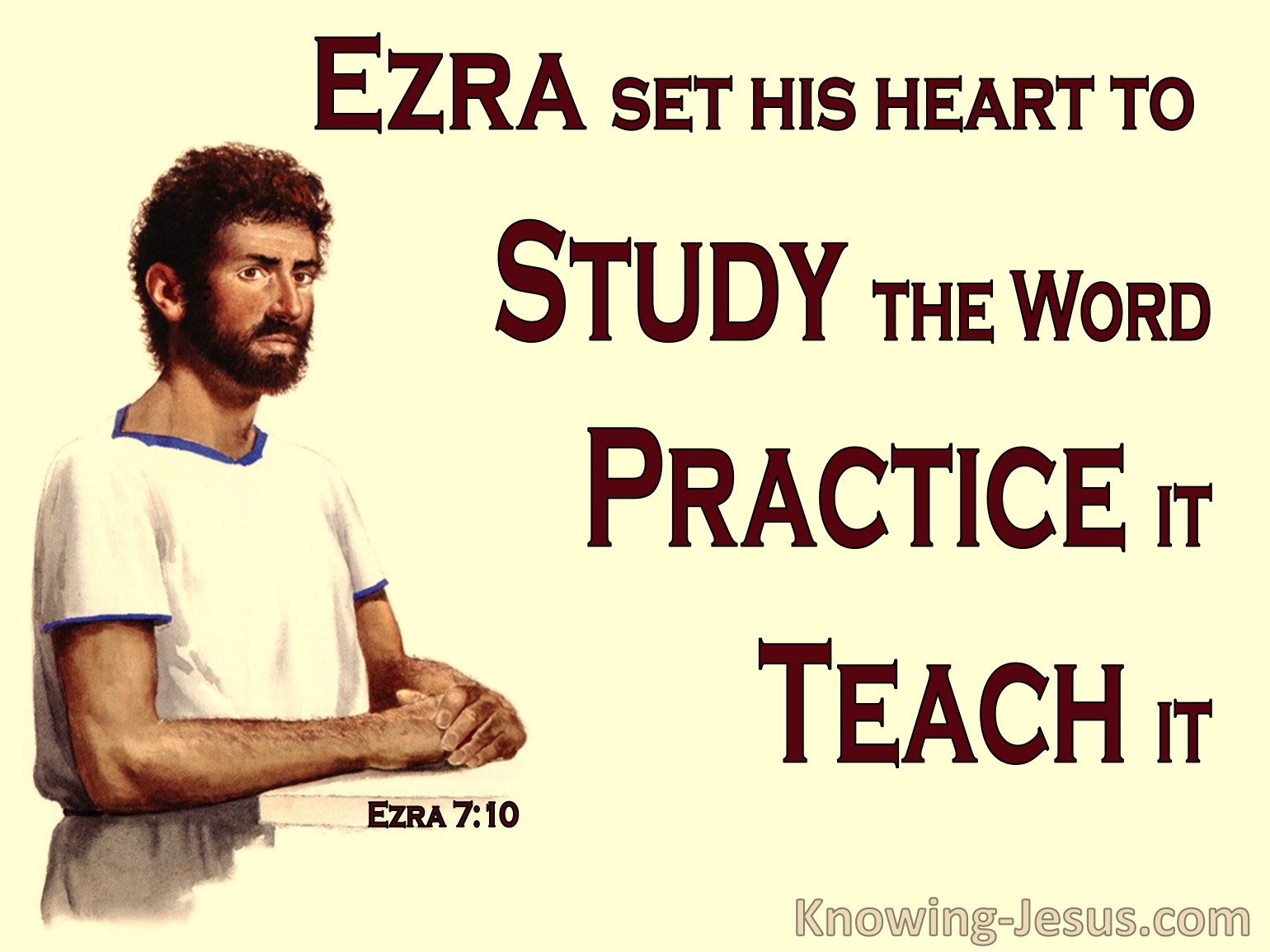
If there is one verse that summarizes Ezra’s life, it is Ezra 7:10:
“Ezra had set his heart to study the Law of the Lord, to practice it, and to teach His statutes and ordinances in Israel.”
This verse is like a three-step plan for spiritual life:
Study the Word – Ezra carefully studied the Scriptures. He did not treat God’s Word lightly but gave his life to understanding it.
Practice the Word – Ezra did not just study; he lived what he learned. His obedience gave him authority.
Teach the Word – Ezra shared the truth with others. His mission was to guide the nation back to God.
This order is important. Many people want to teach before they practice. But Ezra shows us the right way: first learn, then live, then teach.
This is a lesson for pastors, teachers, parents, and every believer today.
5. Ezra’s Leadership Style
Ezra was not a king, soldier, or prophet in the traditional sense. His leadership was different. It was based on teaching, prayer, and example.
Here are some key aspects of his leadership:
5.1 Servant Leadership
Ezra did not use power to control people. Instead, he served them by bringing them God’s Word. He showed humility. His main goal was not his own honor but God’s glory.
5.2 Leading by Example
Ezra practiced what he preached. When he told people to fast, he fasted too. When he told people to repent, he repented too. His life was a sermon.
5.3 Courage to Lead in Hard Times
Leading people is never easy, especially when they are discouraged or rebellious. Ezra faced opposition, sadness, and sin in the community. But he did not give up. He kept pointing the people back to God.
5.4 Focus on Spiritual Renewal
Unlike Nehemiah, who rebuilt the walls of Jerusalem, Ezra rebuilt the spiritual walls of the people. He knew that a city with strong walls but weak faith would still fall. True strength comes from obedience to God.
Lesson for us today: Real leadership is not about position or title. It is about serving, guiding, and helping people to walk with God.
6. Ezra’s Prayer Life and Dependence on God
One of the most beautiful things about Ezra is his life of prayer.
6.1 Prayer Before the Journey
When Ezra was about to travel from Babylon to Jerusalem, he called the people to fast and pray (Ezra 8:21–23). Instead of trusting in human protection, he trusted God’s hand of protection.
6.2 Prayer of Confession
In Ezra 9, we see one of the most powerful prayers in the Bible. When Ezra learned that the people had married foreign wives and disobeyed God’s law, he fell on his knees, tore his clothes, and cried out to God.
He prayed:
Not only for himself, but for the sins of the whole nation.
With deep humility, saying, “O my God, I am too ashamed and disgraced to lift up my face to you.”
Admitting that the people had received more mercy than they deserved.
This prayer shows us the heart of a true intercessor. Ezra did not blame others—he stood with the people and confessed their sins as his own.
6.3 Prayer as a Lifestyle
For Ezra, prayer was not an emergency button. It was his way of life. He prayed before journeys, during crises, and in moments of joy. He leaned on God daily.
Lesson for us today: Prayer is not our last option but our first response. Like Ezra, we should depend on God in every situation.
7. Ezra’s Courage to Confront Sin
Ezra’s leadership was tested when he discovered that many Israelites, including priests and leaders, had married foreign women (Ezra 9–10).
7.1 Why This Was Serious
This was not just about marriage or culture. It was about faith. These foreign wives often brought idol worship with them, which would turn Israel away from God. It was the same sin that had led Israel into exile before.
7.2 Ezra’s Response
Ezra wept and mourned before God. He showed that sin was serious and could not be ignored.
The people saw his grief and gathered around him. His reaction influenced them to also repent.
Ezra led the people to make a covenant to put away their sin and return to God.
7.3 Courage in Leadership
It takes great courage to confront sin, especially when it involves respected leaders or popular practices. Ezra did not seek to please people but to please God.
This was painful and difficult, but it saved the nation from spiritual ruin.
Lesson for us today: Sometimes love means speaking truth, even when it hurts. Real courage is not silence but faithfulness to God’s Word.
8. Ezra and Nehemiah: A Team for God’s People
Ezra’s work did not happen alone. Later, he partnered with Nehemiah, the governor who rebuilt Jerusalem’s walls. Together, they brought both physical and spiritual renewal.
8.1 Ezra Reads the Law Publicly
In Nehemiah 8, Ezra stood before the people and read the Book of the Law from morning until noon. The people listened carefully. Some wept when they heard God’s Word, realizing how far they had strayed.
8.2 Explaining and Teaching
Ezra, along with the Levites, explained the meaning of the Scriptures so everyone could understand. This is one of the earliest examples of expository teaching—reading the Word and then explaining it clearly.
8.3 A Community Revival
The result was a great revival. The people celebrated the Feast of Tabernacles for the first time in many years. Joy returned to Jerusalem. This shows the power of God’s Word to bring transformation when it is read, understood, and obeyed.
Lesson for us today: Teaching and preaching are powerful when done with clarity and sincerity. God’s Word still has the power to bring revival.
9. Spiritual Revival Under Ezra
One of Ezra’s greatest achievements was leading God’s people into spiritual revival.
9.1 What Is Revival?
Revival is not just emotional excitement. True revival happens when:
People return to God’s Word.
Hearts are broken over sin.
Lives are changed in obedience to God.
9.2 Revival in Ezra’s Time
When Ezra prayed and confessed sin, the people gathered around him with tears (Ezra 10:1).
They made a public decision to turn away from sin and follow God’s law again.
Later, when Ezra read the Law (in Nehemiah 8), the people stood in reverence, lifted their hands, bowed their faces, and worshiped.
This was not just an event—it was a movement of the heart.
9.3 Revival Starts with the Word
Ezra shows us that real revival begins with God’s Word, not with music, miracles, or emotions. When the Bible is central, lives are transformed.
Lesson for us today: If we want revival in our churches, families, and communities, we must bring back the Word of God to the center of life.
10. Practical Lessons from Ezra’s Life
Ezra’s story is ancient, but the lessons are fresh and practical. Here are some simple takeaways:
Study God’s Word daily. Like Ezra, set your heart to know the Scriptures. Even a few verses each day can guide your life.
Live out what you learn. Knowledge without obedience is useless. Ezra practiced the Word before teaching it.
Teach others by example. Parents can teach children, pastors can guide churches, and friends can encourage each other.
Pray before big decisions. Ezra prayed before traveling, teaching us to seek God’s help first.
Face sin honestly. Ezra did not ignore sin. He confessed it and helped people turn back to God.
Lead with humility. Ezra served rather than controlled. His strength was in God’s Word, not in human power.
Depend on God’s protection. Ezra trusted God on the dangerous journey instead of relying only on soldiers.
Believe in revival. Ezra saw a whole community turn back to God. The same can happen today.
11. How Ezra Points to Jesus Christ
The Bible is one story that points to Jesus. Ezra is part of that story.
Ezra brought God’s people out of exile and back to worship. Jesus brings us out of sin and back to God.
Ezra taught the Law. Jesus fulfilled the Law.
Ezra prayed for the people’s sins. Jesus died for our sins.
Ezra rebuilt the people spiritually. Jesus builds His church forever.
Ezra reminds us of our need for a Savior. His work prepared the way for the coming of Christ, the Word made flesh.
12. Ezra’s Legacy and Influence
Ezra’s work did not end with his life. His influence lasted for generations.
He helped establish the importance of Scripture reading in public worship.
He trained others (scribes and teachers) to study and explain God’s Word. This tradition continued into the time of Jesus.
Jewish people began to value teaching and studying Scripture as a community, something Ezra helped strengthen.
His devotion inspired later leaders and believers to prioritize God’s Word above everything else.
Today, whenever we gather to read the Bible together, we are walking in Ezra’s footsteps.
13. Reflection Questions for Bible Study
If you are studying Ezra in a group or personal devotion, here are some questions to reflect on:
What does Ezra 7:10 teach us about the right order of studying, practicing, and teaching God’s Word?
How does Ezra’s prayer life challenge your own prayer habits?
Why was it important for Ezra to confront sin, even though it was difficult?
What does Ezra’s faith in God’s protection on the journey teach us about trust?
How can you bring revival into your family, church, or community today?
In what ways does Ezra point us toward Jesus?
14. Ezra’s Relevance for Today’s World
Our world today is not so different from Ezra’s time. Many people forget God, ignore His Word, or follow other idols like money, success, or pleasure. Just like in Ezra’s day, we need leaders and believers who:
Love God’s Word,
Live by it,
Teach it with courage,
And pray with faith.
If we follow Ezra’s example, we can bring light and hope into a dark world.
15. Conclusion: Be Like Ezra
Ezra may not be the most famous Bible character, but his life is a model for every believer. He was:
A man of the Word,
A man of prayer,
A man of courage,
And a man who brought revival.
The story of Ezra reminds us that one person devoted to God can make a difference for an entire community. His mission was not to build walls of stone, but to rebuild hearts of faith.
Today, God is still looking for people like Ezra—people who will study His Word, live it out, and share it with others.